GoTackle
GoTackle is an AI-enabled platform designed to help small-business owners turn ambitious goals into manageable actions.
Year
2025
Scope
UX/UI, Visual Identity, Product Roadmap
Client
GoTackle
Duration
3 months
GoTackle is an AI-enabled platform designed to help small-business owners turn ambitious goals into manageable actions.
I worked alongside the product and founding team to evolve an early collection of static concepts into a more coherent product experience—helping define the information architecture, execution model, interaction patterns, gamification system, and visual experience.
My role
Senior Product Designer
I owned
Product strategy, UX architecture, user flows, interaction design, UI design, prototyping and research synthesis
Team
Founder · Product Manager · Engineering · Product Design
Stage
Early concept → private-beta MVP
At a glance
We moved GoTackle from a collection of loosely connected product ideas toward a structured execution platform centered around one simple question:
What should a business owner do next?
The challenge
Small-business owners rarely have an information problem. They have an execution problem.
Entrepreneurs have access to an enormous amount of advice: articles, consultants, templates, videos, AI tools and business communities.
The harder problem is knowing what applies to their business, what deserves attention now, and how to translate advice into action.
GoTackle wanted to close that gap.
The original vision combined education, mentorship, business tools and AI assistance. The opportunity was compelling, but the early product concepts surfaced a larger design challenge:
How could we bring these capabilities together without creating another overwhelming business dashboard?
Our goal became more specific:
Create an approachable system that could understand a business owner's goals, recommend meaningful next steps and help them make measurable progress over time.
My role
I helped turn the product vision into a system people could understand and use.
Rather than jumping directly into interface design, I worked through the product at several levels simultaneously.
I helped define:
the core problem the product should solve;
how information and actions should be organized;
how AI recommendations should appear within the experience;
how long-term goals could become short-term tasks;
how progress should be communicated;
how gamification could reinforce behavior without trivializing the work;
and how those decisions translated into a scalable interface system.
Discovery
Early concepts showed the vision. Research exposed the product.
Before my involvement, GoTackle had developed several static prototypes exploring different versions of the experience.
They demonstrated what the platform could contain, but user conversations raised a more fundamental question:
What did customers actually need the product to help them accomplish?
Through interviews, feedback sessions and conversations with the founding and product teams, a recurring pattern emerged.
Business owners did not necessarily need another place to collect information.
They needed help deciding:
What matters?
What should I do first?
What should I do this week?
Am I actually making progress?
That shifted our design focus from building a collection of tools toward designing an execution system.
Product strategy
From dashboard to operating rhythm
The research led me to organize the experience around a repeating behavioral loop:
Goal → recommendation → action → completion → progress → next action
Rather than asking a user to continually interpret an open-ended dashboard, GoTackle could progressively narrow the distance between a business objective and the work required to reach it.
I used that model to guide six areas of the experience:
Problem
Make the daily operation of a business easier.
Information
Surface insights from customer, advisor and business data.
Proposition
Create an all-in-one execution environment for entrepreneurs.
Architecture
Organize goals, recommendations, tasks and progress into understandable layers.
User journey
Create reasons to return beyond simply checking information.
Visual system
Make a potentially complex business product feel approachable, motivating and easy to scan.
Designing the experience
1. Make the goal the center of the product
A business owner might say:
Increase sales by 10%.
But that objective is too broad to act on directly.
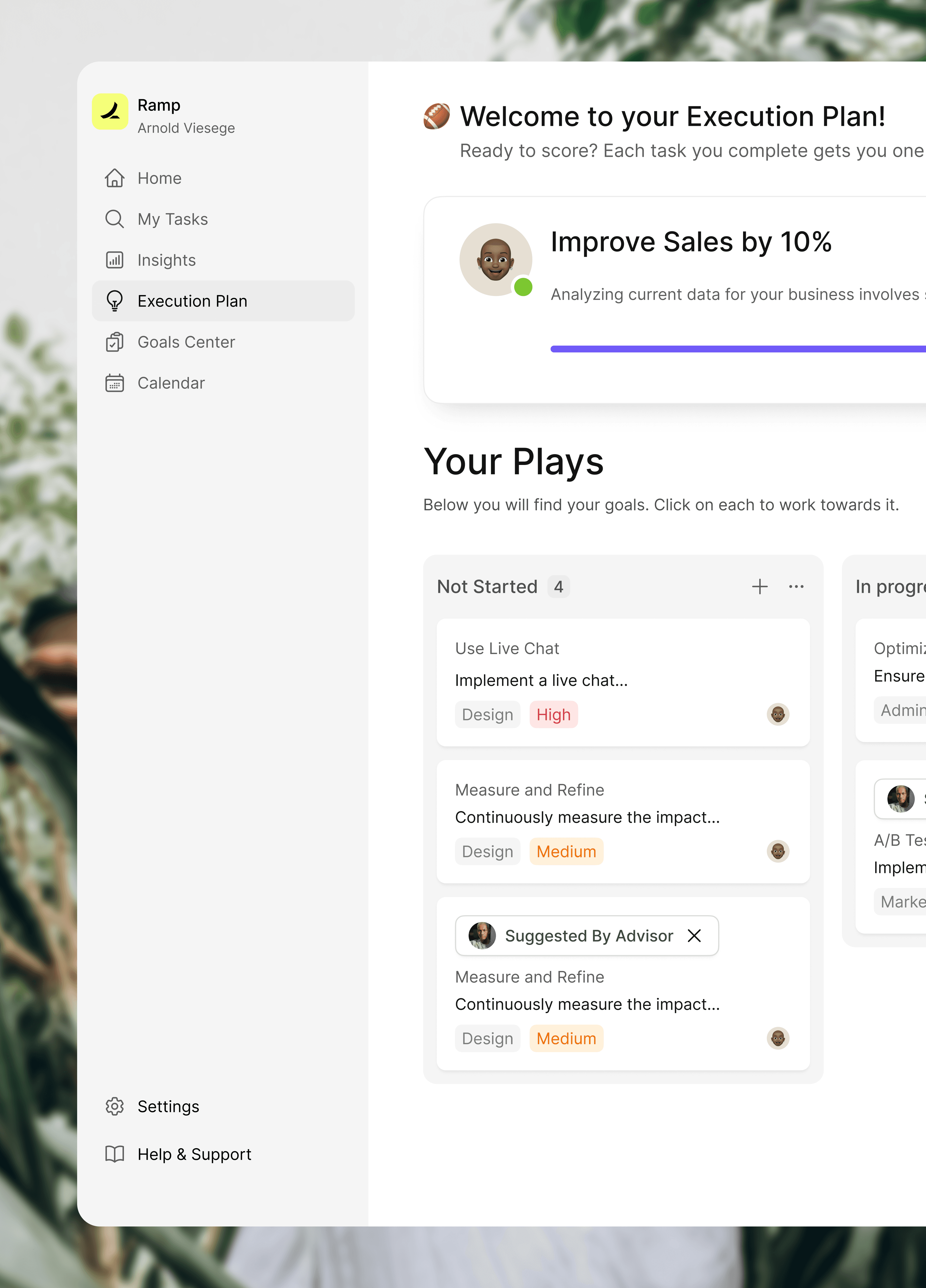
We designed the experience so goals could become structured execution plans containing concrete recommendations, tasks and progress indicators.
Instead of presenting the user with another analytics dashboard, the product could answer a far more useful question:
What can I do today that moves this goal forward?
2. Turn AI into an advisor—not a chatbot
One of the most important product decisions involved the role of AI.
Rather than positioning AI as an empty chat window waiting for prompts, we explored how intelligence could exist throughout the product.
The system could analyze available business information, surface recommendations and generate actionable “plays” related to the user's goals.
This allowed AI to function less like a destination and more like an embedded decision-support layer.
That distinction is very contemporary and worth emphasizing in a 2026 portfolio.
3. Separate knowing from doing
Recommendations alone were not enough.
Users needed somewhere to manage the work those recommendations created.
I designed a task system that allowed entrepreneurs to move recommended actions through a familiar Kanban workflow:
Not started → In progress → Completed
This gave users both flexibility and a visible sense of momentum while allowing GoTackle's recommendations to transition naturally into real work.
The harder design problem
How do you make business execution motivating without making it feel childish?
GoTackle's name created an opportunity.
If a business goal represented the destination, progress could be visualized like movement down a football field.
We developed the brand narrative into the product itself.
AI-generated recommendations became plays.
Completing tasks advanced the entrepreneur toward the goal line.
Meaningful milestones became touchdowns.
The football metaphor created a visual language for progress without requiring users to learn an entirely new productivity model.
But there was an important constraint:
The game could reinforce the experience. It could not become the experience.
The underlying product still had to work as a serious business tool.
So the interface maintained familiar SaaS patterns for goals, tasks and information while reserving the game layer for motivation, orientation and feedback.
Iteration
The product became clearer as we removed ambiguity.
The MVP evolved through multiple product iterations, private-beta feedback and feature-prioritization conversations.
Rather than treating every proposed feature as equally important, I continually evaluated new concepts against the core execution loop:
Does this help the entrepreneur understand what matters or take the next meaningful action?
That principle gave the team a way to evaluate product decisions beyond preference.
Some ideas became core workflows.
Others were simplified, repositioned or deferred.
The result was a product architecture capable of supporting additional tools without losing the central experience.
The solution
A business operating system organized around progress
The resulting MVP brought GoTackle's primary capabilities into one connected environment.
Business owners could:
define the outcomes they wanted to achieve;
receive personalized recommendations;
convert recommendations into actionable tasks;
manage those tasks through an execution workflow;
work alongside an AI-enabled advisor;
and understand progress toward their larger objective.
What began as a broad idea for helping entrepreneurs became a more focused proposition:
GoTackle turns business goals into a plan you can actually execute.
Impact
[100+]
customer interviews informed the product
[4]
major product iterations
[12]
features consolidated into the new architecture
Private beta shipped
with the redesigned execution experience
The most important change we made was conceptual.
Early in the project, GoTackle could have become a collection of useful business tools.
Through research and iteration, we identified a stronger organizing principle:
business owners needed help turning knowledge into action.
Once that became clear, decisions about AI, task management, gamification, information architecture and visual design became considerably easier to evaluate.
The project reinforced something I return to often as a product designer:
A good interface organizes features.
A good product organizes behavior.